Showing posts with label Civil War. Show all posts

Friday, March 23, 2012

Collecting Naval Hat Tallies

An interesting bit of nautical collecting is something called a navy hat tally.  They were ribbons with ship’s names and were worn on both the cloth wheel cap and the tarred straw hats starting around the time of the Civil War, in the U.S. navy.  Some countries also used them on tropical pith helmets.  Wealthy owners of private yachts also had their sailors wear hat tallies with the name of the yacht on the ribbon.  Prestigious steamship lines had their sailors wear hat tallies, often with the steamship line flag embroidered on the ribbon as well.

Circa. 1900 British Bosun's Mate with Hat Tally.
The U.S. Navy 1897 regulation prescribed tallies to be made from navy colored silk ribbon and were one and a half inch wide with the letters of the name of the ship in half inch block letters woven from fine gilt thread or stenciled with gold paint.  The lengths of unissued or unused hat tallies varied from 33 inches to 37 inches.  As a side note, the large diameter cracker jack hat had that had been standard from just after the Civil War was reduced in size by regulation after WWI.

Hat tallies were issued as extremely long ribbons, sometimes as long as 38 inches.  When the hat tally was tied to the hat, a bow was made and the extra long tails were often cut short and neat.  Unissued hat tallies will generally be quite long and tied, issued hat tallies when dismounted from the hat will be considerably shorter.  Retired navy men saved their hat tallies and sometimes cut them down to the legend only for display so expect to see a variety of lengths.

Most major navies had hat tallies and it’s not uncommon to find South American and Italian hat tallies on the market because they are still being used today or were made obsolete only recently.  Hat tallies were not just named ships, but naval duty stations and reserve status might be indicated on a hat tally.


American hat tallies with ship names ended in August 1941, just before America’s entrance into WWII, with the bombing of Pearl Harbor due to security reasons.  Wartime and later hat tallies just said U.S. Navy.  The cracker jack hat went away by the mid 1960s, being a piece of basic issue to new recruits, but seldom worn.


Hat Tally USS Lancaster  1858-1915


Hat Tally USS Machias 1891 to 1919


Be careful of buying hat tallies over the internet.  There are increasing numbers of reproductions being sold as original.  The most common are U.S. Navy hat tallies with the name of famous ships from the civil war to WWII as well as German WWII hat tallies of battleships.


The most common original hat tally is the standard “U.S. Navy” which is worth from $5 to $10 depending on condition.  The post-WWI small navy hat with a common “U.S. Navy” legend sells from $25 to $50, although there are considerable variables in condition.  A named hat from a good ship will bring more and a hat with a pre-war named ship hat tally can be expensive, just be careful of reproductions.

Hat Tally USS Mohican 1883-1921

Hat Tally USS Topeka 1898-1929


This is an rare example of a cross over hat tally. The Kaiser Wilhelm der Grosse (Kaiser Wilhelm der Große) started out as a civilian luxury liner and was converted into a light cruiser during WWI and was sunk in the battle of Rio de Oro in 1914.

Kaiser Wilhelm der Grosse  Luxary Liner-Commerce raider

Norddeutsche Lloyd (NDL) (North German Lloyd) was a Germanshipping company 

Kaiser Wilhelm der Grosse   1897-1914 

Norddeutsche Lloyd (NDL) (North German Lloyd) Logo


Please note that all actual hat tallies featured in the above images are original and from our collection and are available for purchase. Prices upon request.

For further information go to the following web sites:

Early Hat Tallies
Canadian Hat Tallies  
Sailor Caps
Navy Uniform History
Soar Valley Weaving, Home of Cap Tallies


Two Sailors from the USS St. Louis Note Hat Tally on Right.


Saturday, October 15, 2011

Victorian Civil War Era Swords into plowshares Brooch at South Coast Antiques & Gallery-SOLD

The plow has been a metaphor for the peaceful occupation of mankind since the beginning of agriculture thousands of years ago.  In the Bible Isaiah 2:4 says, “They will beat their swords into plowshares and their spears into pruning hooks. Nation will not take up sword against nation, nor will they train for war anymore.”


This gold over lay pin is a perfect example of a mid 19th century peace movement brooch.  It shows a Victorian era plow merged with a saber or sword.  Overlaid on the plow is a peace lily and where the sword meets the plow is a garnet, which in Victorian iconography and jewelry indicates both blood and mourning, which is very appropriate and appear on many Georgian and pre 1860 mourning jewelry items.

The first peace movement documented was a satirical work by the ancient Greek playwright Aristophanes. Titled Lysistrata it was weitten around 441 B.C. protesting the Peloponnesian War.  In the United States, peace societies began to appear starting just after the War of 1812 to the present.  The 1840s saw such literary types as Ralph Waldo Emerson and David Thoreau broaden the appeal of peace groups.  Even during the American Civil War, there was a small peace movement.  After the Civil War peace groups re-emerged from hiatus and continued on to the present time, sometimes blurring the distinction between peace movement and anti-war movement.

Plowshares were not always a peaceful tool as seen it could also sow war as in the dreaded monster Hydra, killed by Hercules as his second of twelve labors in ancient Greek legend.  The Romans used the plow as a weapon and plowed up the Phoenician capital of Carthage after the Third Punic War in 146 B.C. and sowed salt to ensure that nothing would grow in that spot again. 

The plow has been around since humans began to use agriculture some 8,000 years ago, propelling us into the modern age.  The concept in ancient times was that metal was precious and thus was used and reused in various ways, both in war and peace and making that transformation a metaphor for peace. 

This scarce historic jewel is available for viewing at South Coast Antiques & Gallery in Ocean Springs,MS

Sunday, May 22, 2011

Tintypes, Ferrotypes Part Two – how to spot fakes, hopefully.

Most “fakes” are simply honest photographs of reenactors made as a souvenir of a gathering.  The fake part is misrepresentation of age and additional enhancement by placing the photo in a Civil War period case or sticking an original period revenue stamp on the back.

The lowest grade of fake is simply a copied image printed on a computer printer, glued down on a tintype and then lacquered.  These are easy to spot, due to the fact that the thick edge of the paper will be easy to spot and be felt.  This kind of fake is generally used on CDVs, but it does occur on occasion with tintypes.

Poorest type of fake.
Just a piece of thick paper with a laser printed image!
This was sold on eBay.
More sophisticated fakes are made by making a 35 mm slide of an original photo and then via a photographic enlarger exposing the blank tintype with the old image, transferring a unique image onto the plate.  The giveaway is that the image is no longer unique and probably gleaned from a website, eBay, or other photos, or even a book.  Also original processed tintypes will be slightly vignetted and the image will not run right to the edge.

Of course, recasing is another typical way to increase value.  Some dealers may take a good, original photo and place it into a rarer type case to increase the value of both.  Detecting that deceit is much more difficult to prove. Cases can hide clues to a fake as well.  Keep an eye out for modern reproductions of CW period cases.  They can be paired with an original image also.  Just as a note, most tintypes are caseless or have a paper frame, since the cost of a thermoplastic case was generally more expensive than the cost of the tintype when it was new.
An Original Civil War era thermoplastic case
Get familiar with what age and patina on an original tintype might have.  I have seen the gamut from absolutely pristine to bent, worn, emulsion damage, and even rust on both originals and fakes.  Some people paid extra to have brass buttons painted in, blushes added and even backgrounds washed in and uniforms tinted as well.  These areas may often have a raised feeling when touched, although a light wash might not be raised enough to feel.

There are many good dealers and a number of good, modern photographers who are honest and forthright.  Keep an eye out for modern marks and stamps of a contemporary maker.  If you buy, always deal with a known seller of authentic photos who has a verifiable reputation if you want to buy an expensive photo.  There are many good deals out there at flea markets, garage sales and in junk shops, but let your knowledge steer you clear of items that are too good to be true:  tintypes with images of Robert E. Lee, Abraham Lincoln, confederate soldier with dagger, pistol, flag and motto.

Also take into consideration that there were people making tintypes from the late 1850's upuntil well into the 1930's and a few even later.
A circa 1910 swimsuit tintype
with an old fashioned paper frame.

A tintype cameraman in San Antonio, Texas,
Photo by Russell Lee, March, 1939
Use the internet as your tool for research.  There are a number of forums and blogs that talk about original vs fake photography as well as those photographers who make modern photos using 19th century technology who are happy to share their wisdom.  Seek them out.

Here are a few web resources dealing with antique photography.
Photo-sleuth
The Daguerreian Society

Tuesday, April 12, 2011

Commemorating the 150th Anniversary of Fort Sumter at South Coast Antiques.

Today is the 150th anniversary of the firing on Fort Sumter, so I decided to do a post with a bit of historical information not available anywhere else.  Governor Francis Wilkinson Pickens was governor of South Carolina from 1860 to 1862.  He presided over the secession of South Carolina and it's admission to the Confederate States of America.
Governor Pickens authorized the firing on Fort Sumter by SC militia, which is well known as the start of the Civil War, but he also authorized the first shot fired in the civil war when he sanctioned state militia artillery to fire on the Union vessel Star of the West 9 January, 1861 during its attempt to bring supplies to Major Anderson's blockaded garrison at Fort Sumter.  His wife, Lucy Pickens witnessed the bombardment of Fort Sumter from atop a home in Charleston.


Governor Pickens was a life-long politician and diplomat.  He was Minister to England, a state representative several times and later a state senator.  Under President James Buchannan, he served as minister to Russia from 1858 to 1860 where they became close friends with Czar Alexander II, who was the godfather of their child.    Finally he was Governor of South Carolina during secession and the early part of the Civil War.

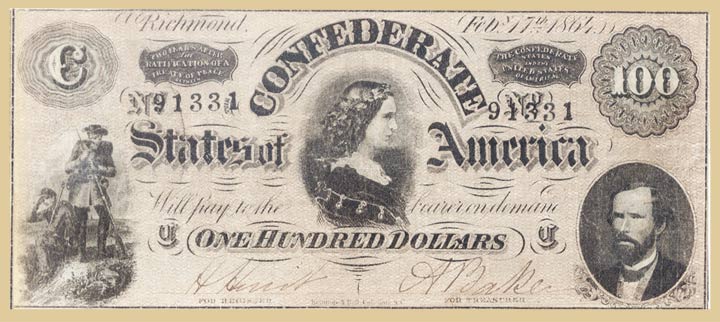
His wife, Lucy Pickens was a master socialite of the 19th century, captivating everybody, even the Czar of Russia.  She was so well known in South Carolina and through America, her face appears on the South Carolina Confederate $100 dollar bill as well as a CSA $1,000 bond.  She was the consummate southern bell and captivated everybody with her intelligence and charm.


This letter was written by Governor Pickens, with an official State of South Carolina letterhead frank to his wife on 4 July 1861.  The letter is short and terse, very unlike typical communications of Victorian couples.  I can only expect that Gov Pickens was distraught and upset.  Perhaps she was in an area of the coast that was threatened by Union invasion and he feared her capture.
We have this letter for view here at South Coast Antiques and Gallery.


Both Francis Pickens and Lucy  Pickens are interred at Willow Brook Cemetery, Edgefield, Edgefield County South Carolina, USA.  Visit their grave sites by clicking on the links.


* Update 28 July 2015 *
A reader recently asked a question about the Lucy Pickens letter and it got me reexamining the envelope, which had previously eluded deciphering despite my familiarity with mid-19th century documents.  So, reinvigorated I went online and pulled up a few other letters written by Gov Pickens from the exact period for comparison and found that he had used runners to deliver letters in some cases. 

On the envelope, I could read “Xxxxfield” which did not match anything I could think of at the time of the first post back in 2011.  But, now I also realized that although his estate was called Edgewood, it was just outside of the town of Edgefield, in the county of Edgefield, where he built his mansion in 1829.  So relooking at “Xxxxfield”, I then understood it was the small town Edgefield, the population of which in 1860 was only 518.  His large estate and mansion was just outside of town and known by everybody in town, cleared up any uncertainty as to destination. 

Next up was some additional instructions written in the lower left hand part of the envelope.  I decided to use some comparisons of other Pickens letters in hopes of at least getting a feeling for his handwriting by sampling.  By pulling up a contemporary letter sent by Gov Pickens to General Beauregard, which was also hand-delivered, it indicated, “By Mr. Green” which meant that this Mr. Green would take it to the general.  It wasn’t a destination, it was a delivery instruction. 

Now since that I knew the letter to Lucy Pickens had to travel a good distance and not by mail.  Scouring period railroad maps, I found no railroads ran by Edgefield from Columbia, a distance of 57 miles, nor were there any convenient rivers that would give an easy steamboat trip, so any travel would have to be by road. 

I then understood the marking read, “By next boy” with a flourish at the end, just like the Gen Beauregard letter.  This letter would have to be hand carried also, by coach or by rider over a long road.  This letter had no stamps and no cancellation, not even a frank marking, which is another reason why I think it was carried by courier – “By next boy”, e.g. by the next runner to Edgefield.

 ------------------------------------------------
                               
                              Mrs F. ??. Pickens

                               Edgefield 

   By next Boy
-----------------------------------------------

Now at least some of the mystery has cleared away, although why Gov Pickens was so abrupt may never be known.  The letter was dated the morning 4th of July 1862 so I wonder of Lucy was supposed to attend a party that night in Columbia.  If so, she probably didn’t make it.  What a shame, Lucy Pickens was one of the great luminaries of the south and her attendance at a party would have made it sparkle. 

Now don’t think that the Confederates didn’t venerate the Founding Fathers, they did.  In fact, the first few years of The United States of America, the United States was unified and operated under the Articles of Confederation.   Eventually the Articles were replaced and the new US Constitution was ratified on June 21, 1788.   Yes, the USA was a confederacy originally and yes, they broke away from “the rightful government of Britain”.  So the government and states of the CSA had every reason to observe celebrate the original American Revolution.  But that’s another story for another time.

I’d like to thank the reader for reminding me of unfinished business with the Lucy Pickens letter as it led me to reread and rediscover its destination.  Sometimes a little time must pass for the dust to settle and the handwriting becomes clearer. 

Friday, April 8, 2011

Historical reenactment , the whole "hardcore vs farb" debate

FARB!There are people out there who wear out dated clothes, they don obsolete even antique uniforms or fashion to recreate earlier times.  They spend a great deal of time trying to be accurate, getting the right accessories and to have the right "persona" for their "impression".  Historical reenactment can recreate the middle ages, the renaissance as well as the Victorian era and the American Civil War.  It covers many ages and many countries, but it always has an interest and reverence for the past.


Sometimes squabbles break out as to who is more correct to the era and egos can be inflated or bruised by a few comments.  Each and every reenactor spends time and money to make their impression as good as they can.  Sometimes even reeneactors lose touch with what they are doing.  I recently turned up a comment on line that really brought home what it is truly all about:

Cody Allen Dillman made this really excellent comment on Facebook Yesterday.
My 2 cents on the whole "hardcore vs farb*" debate, I imagine a group of Civil War veterans coming to a modern reenactment. They wouldn't go "This stitch is wrong" or "You're using the wrong cut jacket". They would come up with tears in their old weary eyes saying "THANK YOU THANK YOU THANK YOU! Thank you for remembering us and what we did." Feel free to disagree.

That my friend, sums it up as far as I am concerned.  Reenactment is a way to honor and remember the past.


*farb is a term of derision about less-than-correct or slipshod costumes, equipment or deportment in an impression.  It gets tossed around a lot.